Find out if your music will be turned down by YouTube, Spotify, TIDAL, Apple Music and more. Discover your music's Loudness Penalty score, for free.

Drag and drop an audio file here

Choose an audio file

MP3 or WAV

select a file

Your file will not be uploaded, stored or shared, meaning this process is secure and anonymous.

Online streaming services are turning down loud songs.

We all hate sudden changes in loudness - they're the #1 source of user complaints.

To avoid this and save us from being "blasted" unexpectedly, online streaming services measure loudness, and turn down music recorded at higher levels. We call this reduction the "Loudness Penalty" - the higher the level your music is mastered at, the bigger the penalty could be. But all the streaming services achieve this in different ways, and give different values, which makes it really hard to know how big the Loudness Penalty will be for your music...

Until now.

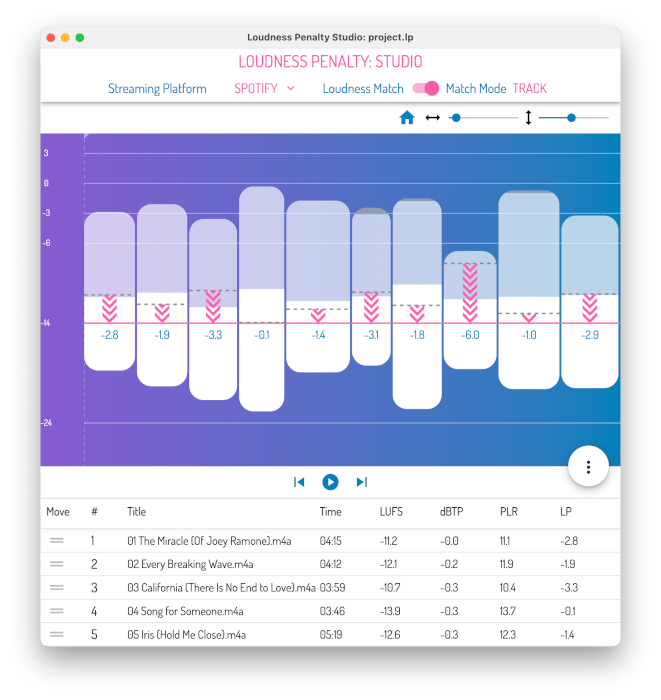
Simply select any WAV, MP3 or AAC file above, and within seconds we'll provide you with an accurate measurement of the Loudness Penalty for your music on many of the most popular music streaming services, and allow you to preview how it will sound for easy comparison with your favorite reference material.

Your file will not be uploaded, meaning this process is secure and anonymous.

Do you have any questions? Get in touch.
Processing audio

(but NOT uploading)

RESULTS (in dB)

0 YouTube
0 Spotify
0 TIDAL
0 Apple
0 Apple (Legacy)
0 Amazon
0 Pandora
0 Deezer

Want to take control of the Loudness Penalty for your music?

Find out how to optimize your music for impactful, punchy playback (and maximum encode quality) for all the online streaming services. Plus, receive a Loudness Penalty Report for your file that explains in detail what all the numbers mean.

Analyze another file

We just sent you an email with your report!

Analyze another file Visit MeterPlugs.com

Raajjvvadmp4 Apr 2026

: Implement a buffer-aware algorithm that prevents stuttering by pre-fetching lower-resolution segments during network dips without hard-switching the quality.

: Reducing data overhead during static scenes saves bandwidth and battery life for mobile users. 3. Implementation Example (Pseudo-Code)

: The user doesn't have to manually toggle settings; the software "just works." raajjvvadmp4

: Integrate a filter that automatically boosts frequency ranges associated with human speech when background noise in the video increases. 2. Why This is a "Good" Feature

The goal of this feature is to automatically optimize the video consumption experience by adjusting playback parameters based on real-time metadata and user environment. Implementation Example (Pseudo-Code) : The user doesn't have

: Automatic audio enhancement makes content more accessible to users in noisy environments or those with hearing sensitivities.

To implement this, you would integrate a dynamic handler within your .mp4 processing pipeline: : Automatic audio enhancement makes content more accessible

: Use a lightweight machine learning model (like a quantized MobileNet) to detect the type of content (e.g., fast-paced action vs. static talking heads).

Scroll down to learn more about "Loudness Penalty"
Scroll down to learn what these numbers mean